Anticipia Rostering · AI for quality decisions
AI drafts the roster against your rules. You decide.
Forecasting, optimisation and an assistant prepare the decision. Each ward’s staffing requirement becomes a draft roster built against working-time rules, rest, contracted hours, skills and absences. You edit it in the grid, ask why, and approve and publish when you are ready.
Three kinds of AI, one decision
Anticipia uses AI as decision support: it prepares the decision and a person makes it. Forecasts are uncertain, an optimiser works only toward the goals it is given, and a language model can be fluent and wrong, so each kind of AI does the work it is good at and shows its limits.
Predictive AI
Forecasting models trained on your organisation’s own history give each ward’s demand as a range, with an expected case and a busy case. They are measured against simple baselines before anyone relies on them.
Prescriptive AI
Mathematical optimisation searches for a roster that keeps every hard rule and scores best on weighted soft goals such as preferences and fairness. It shows the trade-offs it made and how far its roster could be from the best possible score. Its methods come from operational research and constraint programming: they work out how to act, not what will happen.
Generative AI
A language model answers questions in plain language and explains results. It works from the platform’s own results, so each answer can be checked against them. It cannot edit, approve or publish anything; when a change makes sense, it proposes one for a person to apply.
People decide
Ordinary code checks every rule, and the person accountable for the roster makes the call. The AI never has the last word.
From demand forecast to approved roster
Rostering starts from the staffing requirement, not from a blank grid. Anticipia forecasts each ward’s demand from your own data, turns it into the staff each shift needs under your ratios, drafts the roster against it and takes it through approval.
Demand forecast
Admissions, discharges and bed census for every ward, as an expected case and a busy case.
Predictive AI
Staffing requirement
Your ratios, minimums and skill rules turn the forecast into the staff required for every ward, shift and role.
Your rules, applied by code
Roster
The optimiser drafts a roster against the requirement and your rules. You review and edit it in the grid.
Prescriptive AI: optimisation
Approval
Submit, approve, publish. Nothing is published automatically, and every change is logged.
A person decides
Rostering, up close
The roster grid is where managers do their work. Around it sit the tools that give them a draft to start from and a way to change the rules behind it.
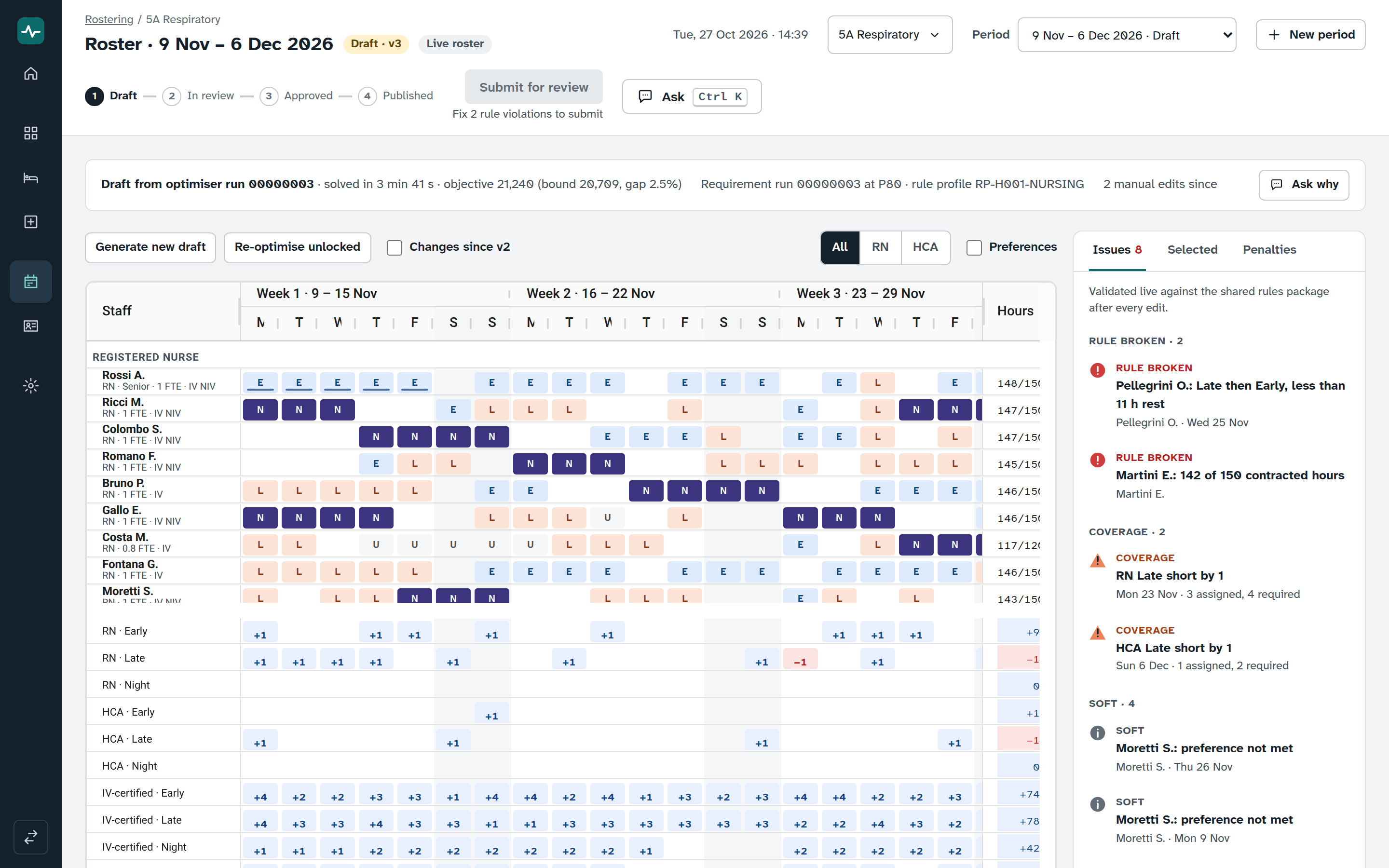
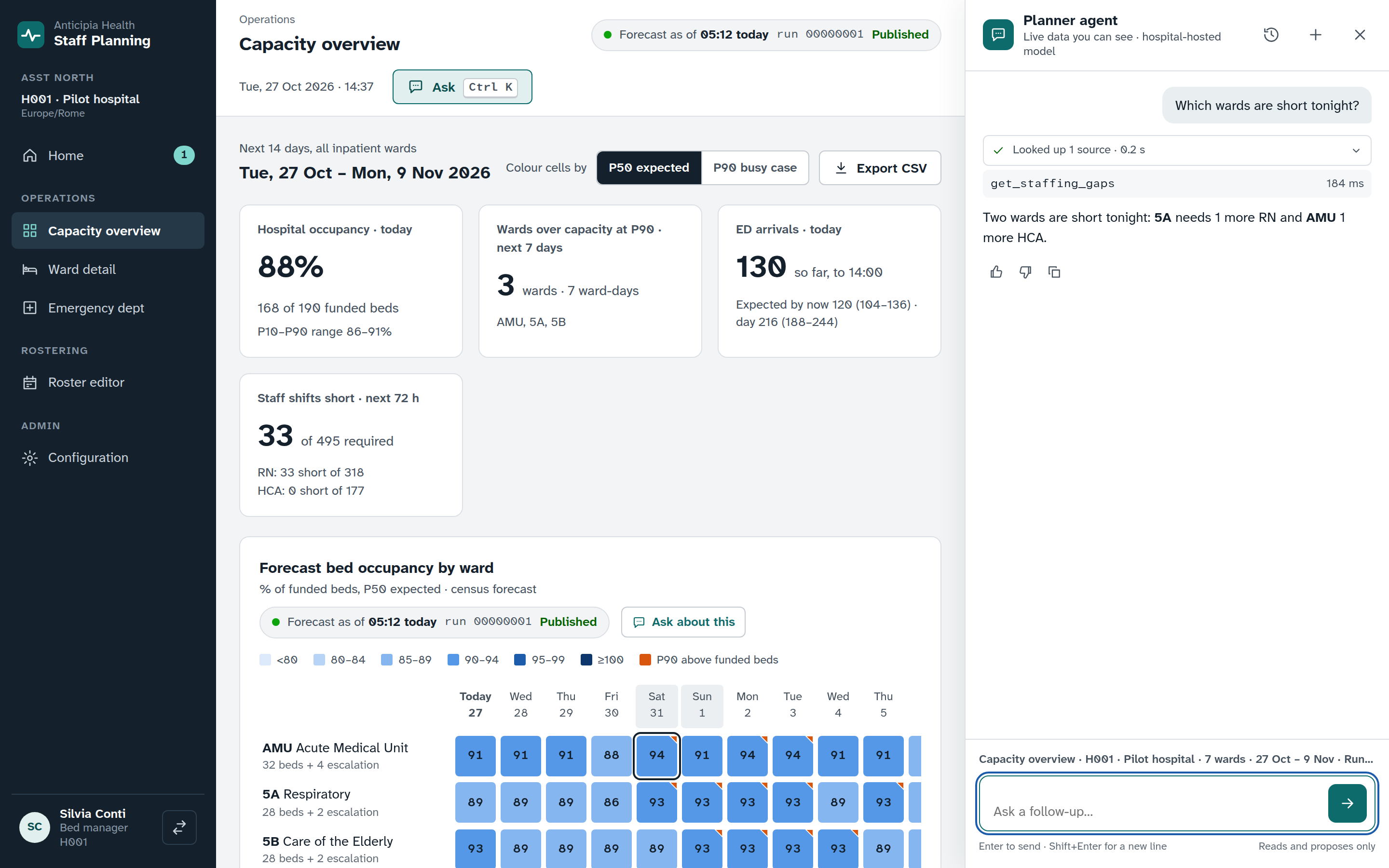
An optimiser that drafts and re-drafts
Lock the shifts you have decided and re-optimise the rest. The optimiser keeps every lock and drafts against your working-time rules, then shows the trade-offs it made, such as how many preferences it could not meet. Use the draft, or change it in the grid.
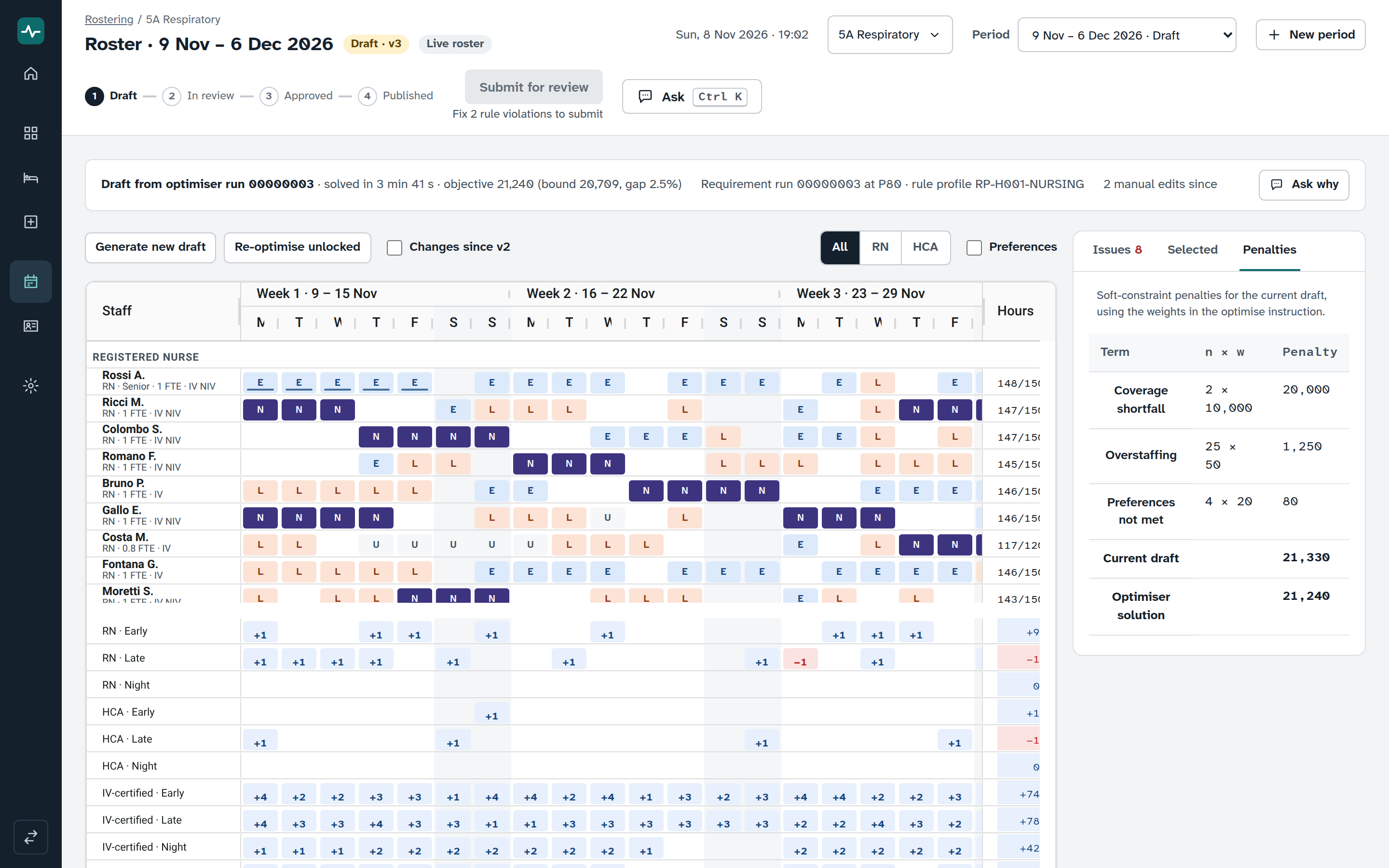
Staffing rules you can change with the impact in view
Ratios and minimums are versioned rules with validity dates. Change one and see the impact preview recalculate the staffing requirement, then save it as a new version from a start date. The rules for past days never change.
One platform, more than rostering
Rostering is the flagship of Staff Planning, and three more products run on the same platform, with the same sign-in, access and assistant.
Staff Planning
How many patients, how many staff, who works when? Demand forecasts and staffing requirements for every ward, which Rostering drafts against.
Hospital Supply Planning
Which drugs and consumables will run low, and what should we order? Order proposals, ward stock, oxygen and a controlled drugs register.
Programme Supply Planning
What does a region or programme need, and how do we fund and move it? Forecast review, supply plan, orders and shipments, and stock.
Disease Forecasting
Where will disease burden rise, and when should we act? An outlook map by district with the chance of crossing a threshold.
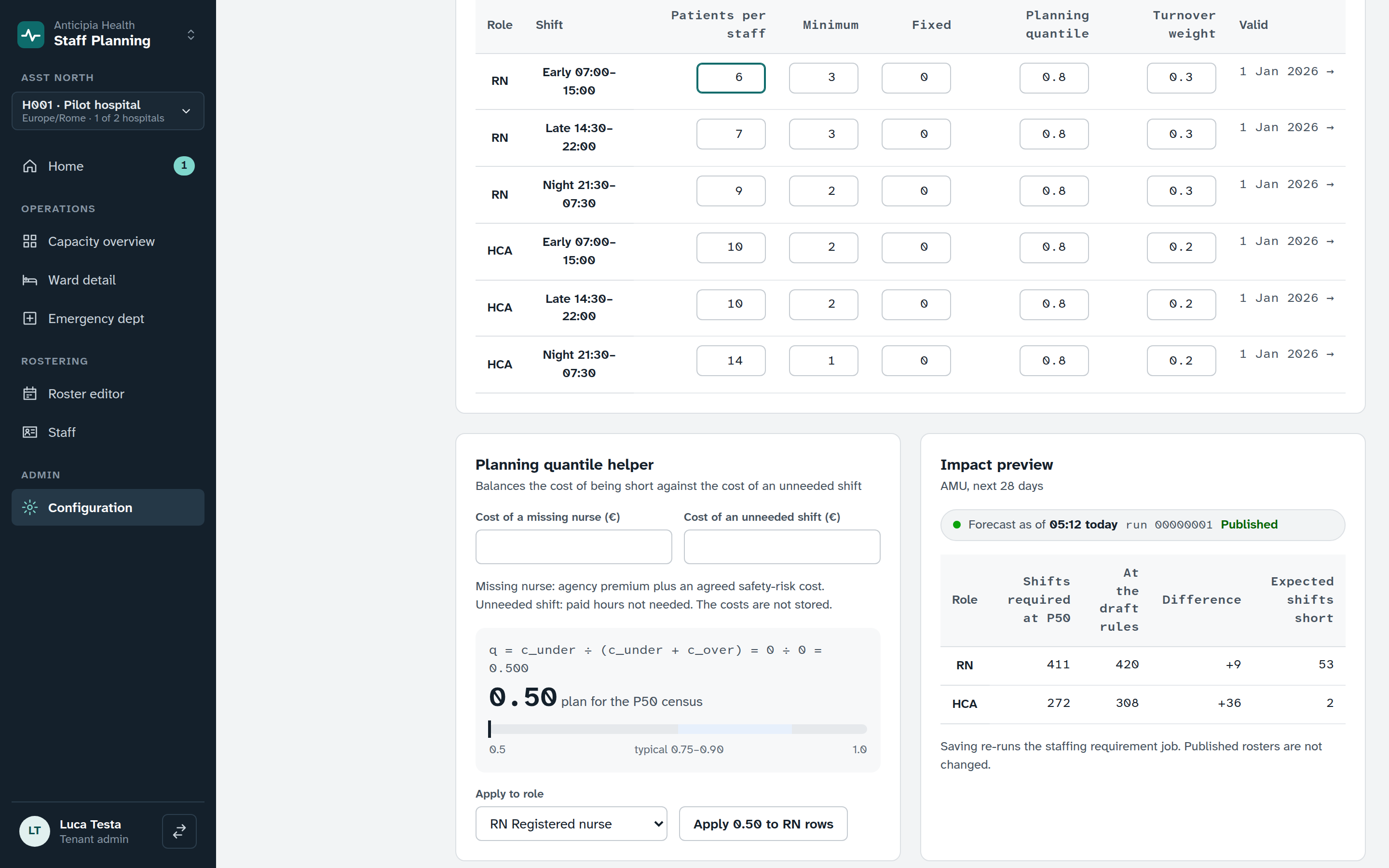
Generative AI that answers from your data
Ask “Which wards are short tonight?” and the assistant answers from the platform’s own results, with its sources and the time of the data. Tables and charts are built from those results. When a change makes sense, the assistant proposes it and a person applies it.
The assistant works with the access of the person who asks. It cannot approve, publish or delete anything.
AI you can check
People can over-trust a machine’s answer. So Anticipia shows forecasts as ranges, the trade-offs an optimiser made, and the sources an answer used.
Rules live in code
Working-time rules, ratios and permissions are checked by ordinary code on every change. A language model never decides whether a rule is kept.
Numbers come from the platform
Tables and charts in an answer are built from the platform’s own results, never typed by a model. Each answer names the sources it used.
People approve
The software drafts and proposes. A person approves every change, and nothing is published automatically.
Deployed where you decide, with pseudonymised patient data
Deployment
- Anticipia can run on infrastructure your organisation controls, in the cloud or on its own servers.
- The language model is your choice: a cloud model or a self-hosted one. An organisation that must not use cloud models never reaches one.
- Staff sign in with their existing account.
Data protection
- Each organisation has its own databases, storage and login.
- Patient data is pseudonymised.
- Support access is audited and time-limited.
- Real patient-level data never goes into development or tests.
See Rostering working
Book a demo and watch a period move from forecast to requirement to draft to approval, with the assistant answering questions along the way.